AVIATION ACCESS TO BE IMPROVED AT CHILDS GLACIER, ALASKA

The Recreational Aviation Foundation is pleased to announce good news for Alaskans and visitors to Alaska seeking access to a US Forest Service campground facing Childs Glacier. On January 31, RAF Alaska Liaison Al Clayton received approval from the US Forest Service for his RAF request for $50,000 to improve and expand the small airstrip just north and east of the glacier’s massive face. “We’re super excited about this good news,” Clayton said.

Clayton, a life-long Alaskan, grew up near the headwaters of the Copper River and worked one summer for Alaska Department of Fish and Game at this location during college. He explains, “The Childs Glacier calves icebergs into the Copper in July when the sockeye run is hot, sending huge waves across the narrow river, sometimes washing salmon up into the alder bushes. This is the natural take-out at the end of a multi-day Copper River rafting trip upstream from Kennicott or Chitina. The scenery and topography are stunning. It is truly a world class location.”

This airstrip lies just north of the 1910 “Million Dollar Bridge” constructed as part of the Copper River & Northwestern Railroad which provided the first rail access from the tidewater port of Cordova, Alaska to interior Alaska. The rail line helped tap the incredibly rich Kennicott copper deposit developed by Stephen Birch with financial support from New York’s Guggenheim and Morgan families. “Books have been written on the challenges of bridge and trestle construction over glacial moraine; and the mining operations that developed in the area. The last ore train ran in 1938, and the towns of Kennicott and McCarthy emptied and alders started reclaiming the railroad right of way,” Clayton added.

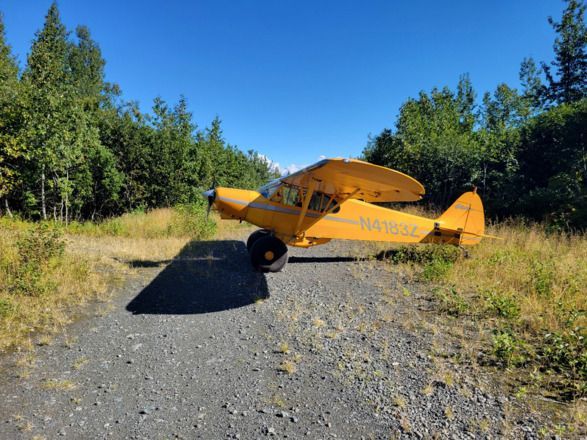
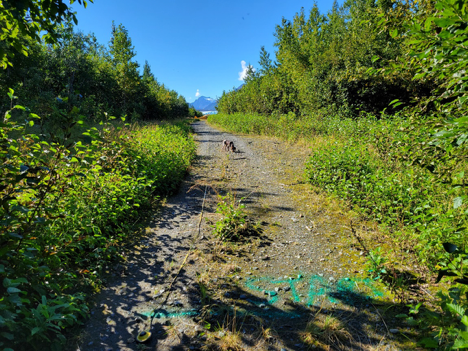
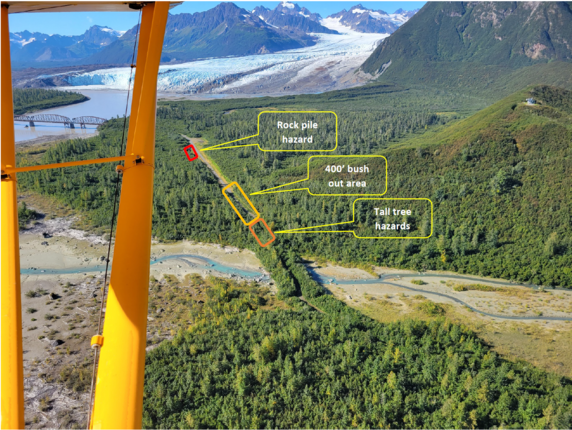
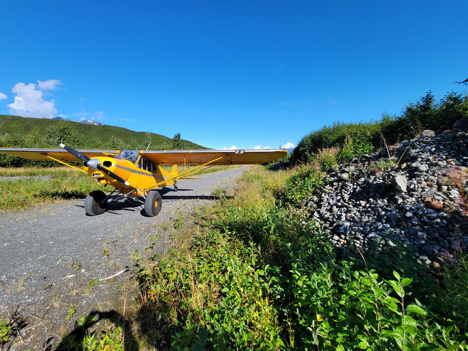
Eventually the right of way was conveyed to the State of Alaska. Fifty-two miles of rail outbound from Cordova were removed and the resulting road to Childs Glacier and the bridge was accessible by motor vehicle. After the 1964 earthquake, the State invested in bridge repairs and the Forest Service built a beautiful campground south of the bridge and across the river from the face of the Childs Glacier. However, modern washouts have destroyed bridges downstream from Million Dollar Bridge, and today the only access to a campground and bridge is over the treacherous river by riverboat; or the present short and narrow “Cub” strip. Adding 400 feet to its north end and cutting cottonwood trees from additional 200 feet will yield a reasonably safe bush strip, according to Clayton’s proposal.

The Recreational Aviation Foundation thanks AOPA and Alaska Airmen’s Association for their support of this project, and is proud of its history of creating and improving airstrips for recreational access.
Photos by Troy Tirrell

Submitted on February 3, 2022.


Posted in News

Recent Posts
April 5, 2026
FEATURING: THE RAF DOG COLLECTION MODELED BY JOSIE & MUD Outfit your four-legged co-pilot for every adventure! From airplane rides to backcountry trails, this collection has everything they need to travel in comfort and style. Featuring two new additions—a stainless steel Orvis dog bowl and DawgMuffs—alongside RAF favorites like the collar, leash, and bandana. This collection includes items designed and created by RAF supporters. Shop the Dog Collection here. If you have questions, please email contact@theraf.org or call 406-582-1723. Your RAF Outfitter purchase is greatly appreciated and furthers the mission to preserve, improve, and create airstrips for recreational access. You can support the RAF mission all year by shopping at the RAF Outfitter online store. Products are being added regularly, and items are thoughtfully selected for durability and suitability for pilots, by pilots. We welcome photos of supporters using RAF gear! Please send your images to ewhite@theraf.org , and let us know if we have permission to post them on social media or our website. Submitted April 5, 2026.
By lellington April 3, 2026
Call To Action Volunteer
March 30, 2026
As you're planning your 2026 flying adventures, remember to review safety briefings for the airstrips you plan to visit. The RAF strongly recommends you review safety briefings and print a copy to have in your airplane - it's even required to fly into some airfields, like Ryan Field (2MT1). For those airfields, pilots flying in are required to review the briefing on an annual basis, and now is the perfect time to catch up on any changes to the runway/area that happened throughout the winter. You can find safety briefings on the RAF Airfield Guide . If an airfield in the Airfield Guide has a required briefing, the airfield listing will clearly indicate it and have a tab to view the briefing. Submitted March 30, 2026 Photo By Jim Stevenson
March 30, 2026
RAF Texas volunteers and Ranger Airfield Foundation volunteers helped begin restoration of the historic 1928 Ranger Airfield hangar on March 28. “A Wright biplane landed here at the field in 1911, and people have been using it ever since,” Ranger Airfield Foundation Founder Jared Calvert said. He noted that Amelia Earhart landed there in a Pitcairn Auto Gyro. Richard Bach, Pancho Barnes, and General Patton also landed at the field. It’s the oldest continuously used turf field in Texas. 
By Carmine Mowbray March 30, 2026
For adventurers seeking access to the Gila Wilderness, we suggest landing at Sacaton Airstrip, NM16, near Buckhorn, New Mexico. The runway lies on a “finger mesa,” and the Rain Creek trailhead lies just northeast of the field. Thanks to RAF New Mexico Liaison Ron Keller's coordination with the USFS using a Cost Share Agreement, Keller was able to organize RAF and New Mexico Pilot Association (NMPA) volunteers to rehabilitate and reopen the long-abandoned airstrip in 2022. Beyond reopening the airstrip, Keller added camping amenities, including picnic tables and a new vault toilet. Most recently, Keller oversaw the installation of new shade structures, most welcoming to campers and hikers. RAF and NMPA volunteers complete ongoing maintenance at Sacaton and other airfields in the Gila National Forest. You’ll see white-painted rocks along Sacaton’s 3,989-ft dirt runway, and surrounding the segmented circle near the RAF windsock. The airstrip lies at 6,200-ft elevation, so pilots should be mindful of density altitude while flying over high terrain in the vicinity, even in winter temperatures.  “Anglers will enjoy plying streams for the rare native copper-colored Gila trout, once a threatened species,” Keller reports. The mile-and-a-half trail to the crossing at Rain Creek is narrow and challenging and traverses a variety of terrain, but the serious hiker will be rewarded trekking through steep canyon walls lined with green alder, willow, and boxelder, hoodoos, and eagle aeries above. There are rumors of a double waterfall some distance on the west fork of Rain Creek trail. See the Sacaton page in the Airfield Guide for more details. Note that the airstrip may be unusable due to snow or after heavy rains. This runway should be considered one-way in/one-way out to avoid overflying the Wilderness boundary. There is a 4.6% upslope to the East, favoring landing Runway 08 with right traffic, remaining clear of the Wilderness east and north of the airfield. Please consider others seeking a Wilderness experience. Prior to landing at Sacaton, permission is required by calling the USFS Gila Dispatch center at 800-538-1644. Please familiarize yourself with Sacaton in the Airfield Guide and the New Mexico Pilots Association Safety Briefing . Submitted March 30, 2025 By Carmine Mowbray