Pat Hartness

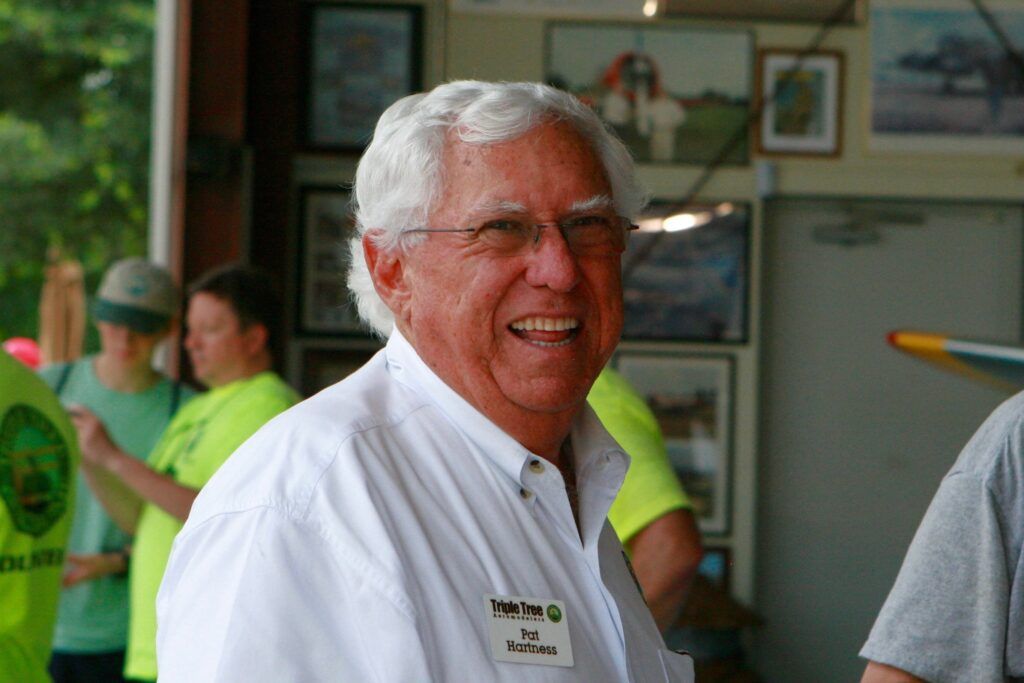
Pat Hartness laid aside his logbook at age 75 after a remarkable life in aviation.“It was the perfect opportunity to start driving a tractor and still stay actively involved in aviation,” he says. It opened a new chapter of his passion to inspire others. After 8,000 VFR hours in everything from PiperCubs, an AirCam, Stearman, to a P-51, and a lot of grease under his fingernails, he gets just as much pleasure sharing the joy of flight from the right seat, or terra firma.


Both his parents had flown for the Civil Air Patrol, which ignited Pat’s early interest in aviation. Now he finds joy in his family partnership – that includes friend and pilot Pat Derrick – managing Triple Tree Aerodrome in Woodruff, South Carolina. Along with his wife, Mary Lou, Pat gave the land to Triple Tree Aerodrome, the 501c3, that now includes an aircraft museum and seven thousand feet of groomed turf in the middle of their 400 acres of beautiful South Carolina. During scheduled events, they invite everyone to land, camp under their wing, stroll through their remarkable collection of aircraft, or enjoy their four-star Hotel Hartness just a few minutes from the field. Who wouldn’t be excited to stay in the resort that Travel and Leisure rated “First in the State” – and Number Three in the nation?


Pat explains that, “Our partnership set up the charity in order to continue maintaining it all as ‘Everybody’s Airport’. We’re boutique,” he added. “We’re not interested in commercial development, or hosting vendors, just interested in people.” He pointed out that they’ll host 80,000 visitors a year. They state that the place is “two-and-a-half times the size of Disneyland,” and his wife Mary Lou and their entire family all take part in the aerodrome business, and managing the hotel. 


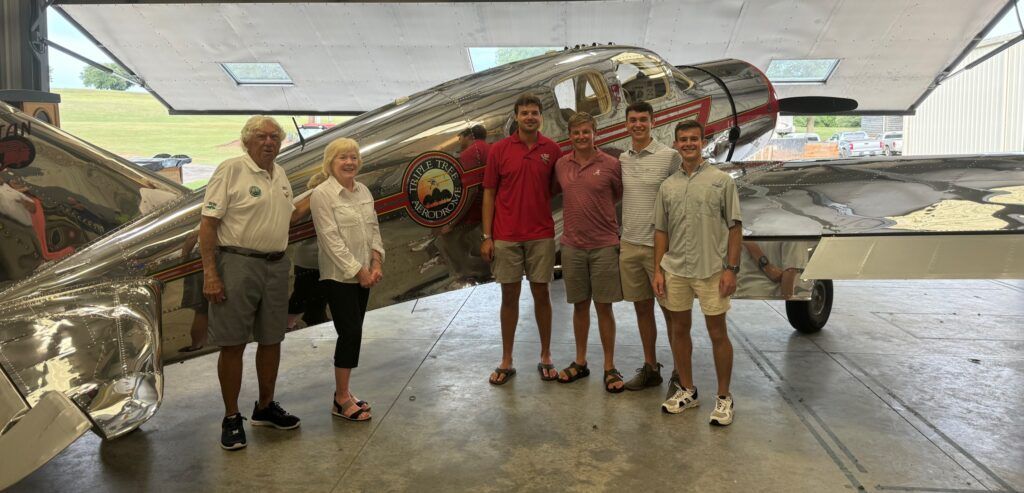
A large part of Pat’s joy comes from mentoring young people. “We’re passing the torch to these young people,” he said proudly. Pat encouraged one youth to fly Triple Tree’s Piper Cub to each state in the Lower 48. “He had to wait for thermals to make it over Homestake Pass,” Pat said, “but he said the scenery was awful pretty on the way down. We challenge young people like that. We believe in them, they are competent,” he added. A man of his word, in July, he sent that young man and three other young pilots off in the museum’s 87-year-old 450-hp Spartan Executive to AirVenture, to negotiate the hubbub of mixed aircraft, all arriving at OSH at different airspeeds. “Their combined ages were less than the age of the airplane,” he exclaimed.
Another way Pat inspires others is by hosting a huge group of radio-controlled aircraft enthusiasts. He trains and mentors them, and says that probably 70 to 80 percent go on to fly powered flight, many commercially. “You can learn an awful lot flying a radio-controlled aircraft safely. It teaches the principles of flight, and an RC aircraft requires every input, accurately,” he said. Annually, RC enthusiasts comprise about half of Triple Tree’s total attendance.


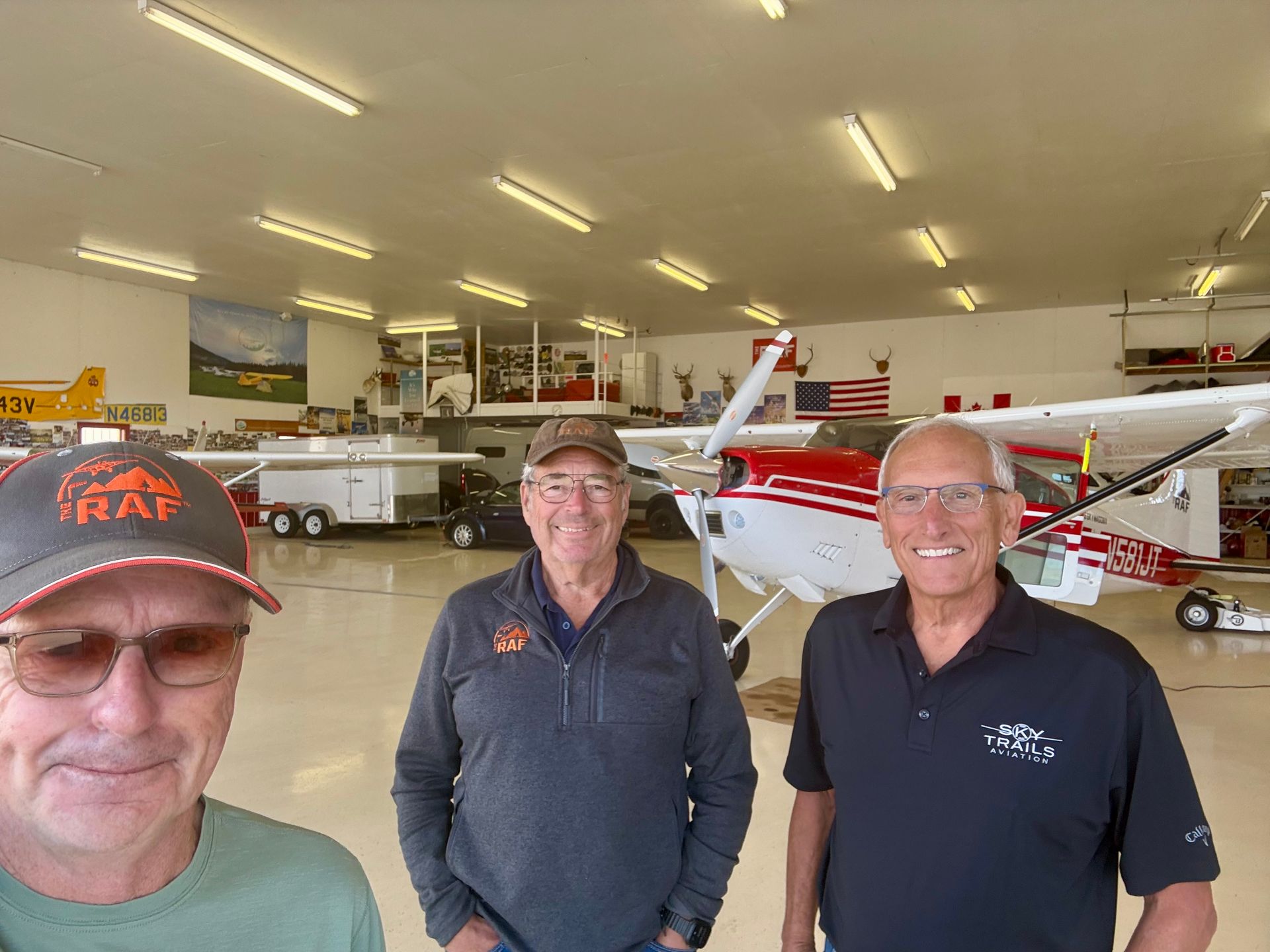
Pat met the RAF at Lakeland, FL around 2006, about the same time Triple Tree started their full scale fly-ins, and he immediately became a supporter. “We have similar missions – people who are putting airports together. It’s what we are all about,” he said. Like the RAF, Triple Tree welcomes volunteers who often use their vacations to pitch in maintaining the place in pristine condition, and it’s obvious they come and work for something more than Pat and Mary Lou’s free lunch. 


To ensure that passion for aviation continues, Pat points out that profits from aerodrome activities go into flight scholarships, amounting to $25,000 each year. Pat is working toward expanding their on-site education center for folks of all ages to embark on aviation’s learning path. The aerodrome hosts summer camps for both GA and RC students, an entire portfolio of learning opportunities in its Aviation Centered Education, or ACE programs. Pat supported the development of AviCom – the first ever simulated flying competition for high school teens.


In closing, Pat invites everyone to Triple Tree’s annual week-long fly-in September 23-29. “It’s like no other airport. Bring your fishing pole, hiking shoes, and plan on making some friends,” he said.


See ww.tta.aero for details, and scheduled events.

Submitted September 17, 2024
By Carmine Mowbray


Recent Posts

By Steve Jones December 15, 2025
AR Ambassador
By Kodi Myhre December 11, 2025
At about this time, every year, we have this conversation at the RAF about what our year end letter (code for asking for your financial support) should say to you, and about the RAF and the accomplishments of the past year.
By Taylin Trafton December 11, 2025
A Christmas gift of flight lessons from his parents started Scott Anttila’s aviation journey in 1985. “I learned at Johnson Field, a small grass strip tucked into the woods in Michigan’s Upper Peninsula, and that early exposure to simple backcountry flying stuck with me,” Scott says. Growing up in the U.P., he spent a lot of time outdoors and found that flying was another way to get to the places he liked to explore—especially the ones most people never saw. As he earned more ratings and eventually moved to the Detroit area for work, Scott realized he needed a way to stay connected to northern Michigan. He bought an airplane and used it to get back to the smaller airstrips and lake country he enjoyed. Along the way, he also flew gliders out of Frankfort, soaring along the Sleeping Bear Dunes and towing sailplanes over the Great Lakes. “Those flights gave me a different appreciation for the landscape and made me even more interested in the small, out-of-the-way airports scattered around the state,” he says. Visiting those kinds of places, Scott first came across the Recreational Aviation Foundation. He started using RAF-supported airstrips both inside and outside Michigan. “I noticed how well-kept they were and how much access they opened up,” he says, adding, ”Over the years, I’ve watched a number of grass strips close, which made the RAF’s mission feel especially important to me. Maintaining these airstrips keeps aviation connected to the outdoors and makes it possible for more people to reach the quiet, remote areas that inspired me to fly in the first place.” Scott joins the other two RAF Michigan Liaisons, General Grant and Tanmoy Ganguly. He can be reached at santtila@theraf.org . Submitted December 11, 2025.
By Taylin Trafton December 11, 2025
“The word that comes to mind when I think of our second Walker Ridge work party is magical,” RAF California Liaison Doug Lumgair said, "even though it started off again with a truck stuck in the mud.” Volunteers began arriving Friday afternoon in a tailwheel Rans, a Super Cub, and Lumgair in his Cessna 170. A pickup with a big dump trailer brought the Polaris Ranger, and more pickups arrived. The runway surface posed major problems with boulders protruding from the surface. Everyone was eager to get started with pry bars and remove them. Once they fired up the generators to power the hammer drills, they discovered that this was the best method for attacking the rocks below the surface and breaking them up into pieces that they loaded into the trailer for removal. “At times, it felt like we had taken on an impossible task. But with steady work and persistence, by afternoon, we began to see the light at the end of the tunnel,” Lumgair said.  In the Friday evening fire circle, they made new friends while sitting around a propane fire pit that had been cleverly transformed into a radiant heater by placing a washing-machine drum over it. Walker Ridge lies in a dark-sky area. Before the full supermoon rose, Lumgair said they could see the Milky Way with the naked eye. The campsite at the south end of Walker Ridge has a gorgeous view of the valley, and the view became “even more breathtaking as Central Valley tule fog filled the valley and the supermoon lit the fog, creating a shimmering white lake.” Lumgair said. Saturday morning, two crews quickly organized with hammer drills, and others began cutting brush along the runway edges. Volunteers had already removed what Lumgair called an incredible amount of brush during their first work party, but Saturday, they hauled out twelve more trailer loads. Late on Saturday, they had enough time to work on the rock outcroppings in the south turnaround area as well. "It was amazing that we were able to cut and haul so much brush and break down rocks and fill the resulting holes—all in one steady, hard-working day. Thank you very much to everyone for supporting the RAF in so many ways,” he said. Some stayed Saturday night to enjoy another beautiful evening. Work remains, and Lumgair is planning more work parties in the coming year to complete further improvements, some of which will require additional approval from the BLM. “Please let me know if you get up there this winter. I’d love to hear your thoughts and see any photos of your experience, Lumgair added. Doug Lumgair can be reached at dlumgair@theraf.org . Submitted December 11, 2025.
By Taylin Trafton December 9, 2025
Chris at TacAero in Fredericksburg, Texas to fly what he calls, "the mighty XCub. It's an awesome airplane,” he added.