Lynn Mareth

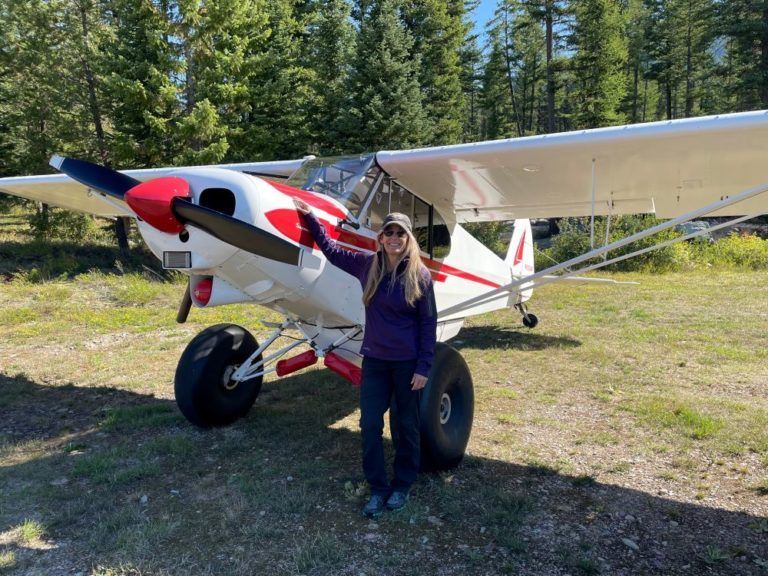
There is no idle season for RAF supporter and hard working volunteer Lynn Mareth, now of Bigfork, Montana. If her Super Cub has to wait out the “soggy turf” season at her home airfield of Ferndale, she can be found on the slopes of Whitefish Mountain or out riding one of her horses along the Flathead River, or she might be helping her husband RAF Director Mike Perkins refresh duck boxes in time for merganser and wood duck nesting season at their home along the Swan River. The couple moved to Montana from their mile-high airfield home in Berthoud, CO in 2019, but have spent most summers at a second home in Bigfork since 2013. After settling into her new location fulltime, she wanted to connect with other active women so she started a women’s adventure group on Facebook, and it now has over 300 members. It has succeeded in connecting active women who enjoy all things outdoors like hiking, kayaking, paddle boarding, skiing and horseback riding.

Lynn was born in New York and raised in Connecticut. She met Mike at Purdue University while they were earning degrees in computer technology and business. Lynn graduated in 1997, and worked for Kiwanis International as a systems analyst and designed their new in-house IT system. As soon as they could, Lynn says, “we high-tailed it out of Indiana for the mountains of Colorado.” The couple settled in Boulder and started a tech company, which they ran for 22 years before selling in 2019.

Mike’s grandfather had been instrumental in New Hampshire aviation. Mike had always wanted to fly but his duties in the Air Force did not include flying. Lynn bought flying lessons for him in 1999 and “he took to it quickly, and had his Private within two months,” and purchased their Cessna 180 soon after. But Lynn was one of those who prefers to jump out of airplanes – especially when the jump ship was intentionally flown low on gas, and skydivers were instructed to “get out now” each time the engine quit aloft, so she was pretty leery of flying very far in small airplanes.

She decided to learn to fly to be a reliable backup for Mike. Her flight instructor made her uncomfortable when he told her he’d had a troubling vision of a tragic event that involved her in the Skywagon. A few years later, Lynn and Mike were flying home from Idaho’s backcountry with their German Shepherd when a rocker arm boss broke and they experienced immediate engine failure. “Mike was on top of his game,” Lynn said, and got it into an abandoned airstrip at nearly 8,500 feet MSL, safely landing downwind, since there was no windsock. “We were ninety seconds to the ground,” she said. An FAA representative told them that that kind of failure usually kills people. “After that emergency, I figured that was the event. I was free of bad omens and was much more comfortable flying the 180,” she explains.

Lynn’s heart was set on a Super Cub, and she borrowed from her 401k, and sold her beloved BMW sports car in order to buy one. Mike flew all over the West, and eventually found one in Billings in 2006 with about 1,500 hours on the engine. Lynn trusted Blackstone Labs for an oil analysis on the older engine, and so far, has flown her Cub over 1,000 hours more.
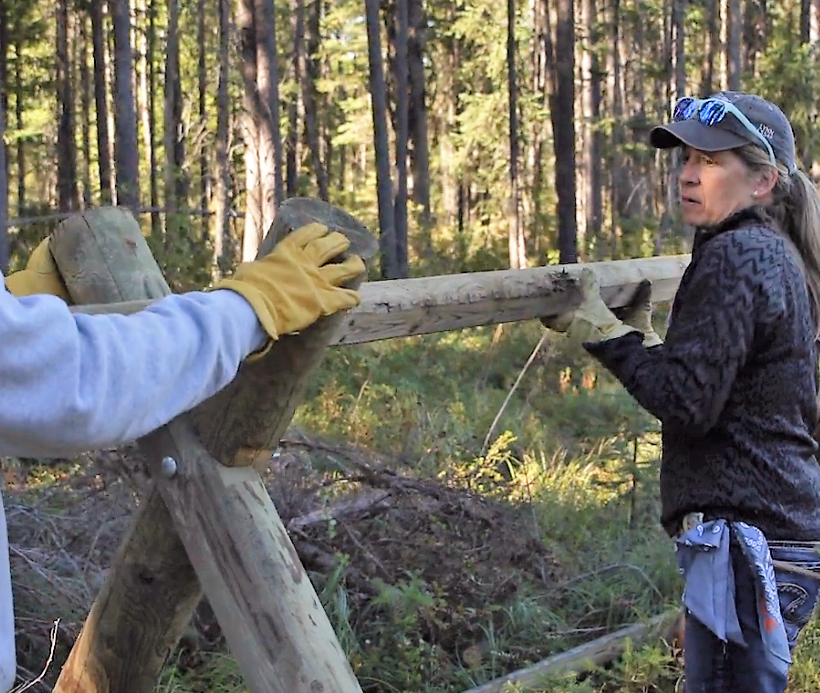
Lynn and Mike were very involved with the Cessna 180-185 Club and with Mike becoming a new Director, they hosted the Cody, Wyoming Skywagon Convention in 2011. Mike invited John McKenna to speak to the group about the RAF and it really inspired the couple to become more involved in the organization. It seemed to be exactly what they love about flying, especially since they now owned both a Cessna 185 and a Super Cub, both capable backcountry airplanes. Visitors to Ryan Field often see Lynn arrive in her red and white Super Cub with the big tires, but she hasn’t dropped in just to relax. Lynn is always one of the first to put gloves on and work hard. “I’m very proud of the work that has been done at Ryan Field by so many volunteers and I’m so grateful that it’s located in our flying backyard,” she says.

“We envision piling in the Skywagon, doing a cross-country, visiting all the RAF airstrips someday,” she says, adding, “North Fox Island was definitely a treat, and it’s amazing how the RAF has grown. It’s really exciting to see how it all started, where we are now, and to envision where we are going in the future.”

Submitted on March 14, 2022.


Recent Posts

By Steve Jones December 15, 2025
This is a subtitle for your new post
By Kodi Myhre December 11, 2025
At about this time, every year, we have this conversation at the RAF about what our year end letter (code for asking for your financial support) should say to you, and about the RAF and the accomplishments of the past year.
By Taylin Trafton December 11, 2025
A Christmas gift of flight lessons from his parents started Scott Anttila’s aviation journey in 1985. “I learned at Johnson Field, a small grass strip tucked into the woods in Michigan’s Upper Peninsula, and that early exposure to simple backcountry flying stuck with me,” Scott says. Growing up in the U.P., he spent a lot of time outdoors and found that flying was another way to get to the places he liked to explore—especially the ones most people never saw. As he earned more ratings and eventually moved to the Detroit area for work, Scott realized he needed a way to stay connected to northern Michigan. He bought an airplane and used it to get back to the smaller airstrips and lake country he enjoyed. Along the way, he also flew gliders out of Frankfort, soaring along the Sleeping Bear Dunes and towing sailplanes over the Great Lakes. “Those flights gave me a different appreciation for the landscape and made me even more interested in the small, out-of-the-way airports scattered around the state,” he says. Visiting those kinds of places, Scott first came across the Recreational Aviation Foundation. He started using RAF-supported airstrips both inside and outside Michigan. “I noticed how well-kept they were and how much access they opened up,” he says, adding, ”Over the years, I’ve watched a number of grass strips close, which made the RAF’s mission feel especially important to me. Maintaining these airstrips keeps aviation connected to the outdoors and makes it possible for more people to reach the quiet, remote areas that inspired me to fly in the first place.” Scott joins the other two RAF Michigan Liaisons, General Grant and Tanmoy Ganguly. He can be reached at santtila@theraf.org . Submitted December 11, 2025.
By Taylin Trafton December 11, 2025
“The word that comes to mind when I think of our second Walker Ridge work party is magical,” RAF California Liaison Doug Lumgair said, "even though it started off again with a truck stuck in the mud.” Volunteers began arriving Friday afternoon in a tailwheel Rans, a Super Cub, and Lumgair in his Cessna 170. A pickup with a big dump trailer brought the Polaris Ranger, and more pickups arrived. The runway surface posed major problems with boulders protruding from the surface. Everyone was eager to get started with pry bars and remove them. Once they fired up the generators to power the hammer drills, they discovered that this was the best method for attacking the rocks below the surface and breaking them up into pieces that they loaded into the trailer for removal. “At times, it felt like we had taken on an impossible task. But with steady work and persistence, by afternoon, we began to see the light at the end of the tunnel,” Lumgair said.  In the Friday evening fire circle, they made new friends while sitting around a propane fire pit that had been cleverly transformed into a radiant heater by placing a washing-machine drum over it. Walker Ridge lies in a dark-sky area. Before the full supermoon rose, Lumgair said they could see the Milky Way with the naked eye. The campsite at the south end of Walker Ridge has a gorgeous view of the valley, and the view became “even more breathtaking as Central Valley tule fog filled the valley and the supermoon lit the fog, creating a shimmering white lake.” Lumgair said. Saturday morning, two crews quickly organized with hammer drills, and others began cutting brush along the runway edges. Volunteers had already removed what Lumgair called an incredible amount of brush during their first work party, but Saturday, they hauled out twelve more trailer loads. Late on Saturday, they had enough time to work on the rock outcroppings in the south turnaround area as well. "It was amazing that we were able to cut and haul so much brush and break down rocks and fill the resulting holes—all in one steady, hard-working day. Thank you very much to everyone for supporting the RAF in so many ways,” he said. Some stayed Saturday night to enjoy another beautiful evening. Work remains, and Lumgair is planning more work parties in the coming year to complete further improvements, some of which will require additional approval from the BLM. “Please let me know if you get up there this winter. I’d love to hear your thoughts and see any photos of your experience, Lumgair added. Doug Lumgair can be reached at dlumgair@theraf.org . Submitted December 11, 2025.
By Taylin Trafton December 9, 2025
Chris at TacAero in Fredericksburg, Texas to fly what he calls, "the mighty XCub. It's an awesome airplane,” he added.