WORTH THE READ: JIM HANSON GUEST EDITORIAL

Our many RAF supporters have such vast and varied experience, and we’re capturing some of their words of wisdom to share with you. This month’s guest editorial is from Jim Hanson, a career aviator and longtime RAF Supporter.

The RAF Turns 20:

There is so much to be proud of on this 20th anniversary of the RAF! Searching for a way to illustrate this, it occurred to me that creating a large organization or business is much like bringing up your own child. YOU gave it life – YOU molded it into the success it has become. The success of the RAF is a reflection on YOU, the “parents.” Here are some lessons learned from my own parents, who brought up six kids, applicable to starting and managing a business, or an organization like the RAF:

  1. When the “baby” is young, it is all-consuming; you think about it every waking minute, and in turn, it keeps you up all night.
  2. In the beginning, the “baby” needs to be changed—A LOT!
  3. As it gets older, it starts to develop its own personality and identity—with or without your input.
  4. The saying “it takes a village to raise a child” couldn’t be more true—you need help and input from many people.
  5. The “older kids” help bring up the “younger kids”—imparting “tribal knowledge” and wisdom to the younger kids, as well as helping out the parents.
  6. As an adolescent, the kid thinks he or she knows everything, and will only find out after making mistakes that they do not.
  7. As your “youngster” matures, you take increasing pride in their accomplishments.
  8. As it reaches adulthood, your “child” has fully assumed its own identity, and you realize it can function without you. You can (and should) be proud of that fact!

That has certainly been the case with the RAF!

To continue the analogy of a person or organization growing from a young child to an adult, I offer the following examples from my parents (and you likely heard it from your own). Whether bringing up kids, or starting a business or organization, these attributes are applicable:

  • “Always associate with people smarter than you” (in my case, that isn’t a problem!).
  • “Don’t make promises you can’t keep”.
  • “Under-promise, and Over-deliver!”
  • “Don’t be afraid to ask for help—we all need it at some time, and you can learn from the failures of others.”
  • “By helping others, you often help yourself.”
  • You have one chance to make a “First Impression”.
  • The most valuable commodity you have is people’s confidence in you to “do the right thing”—don’t let them down.
  • “Just because _____ acts that way doesn’t mean YOU have to! Be your own person!”.
  • “Do a few things, but do them well.”
  • “Don’t be afraid to make mistakes—we all make them—but be sure to learn from your mistakes.”
  • “Much can be accomplished if you don’t care WHO gets the credit!”
  • “Respect (and reputation) is earned, not granted.”
  • “It’s not WHO you know—it’s who knows YOU—and what you stand for!”
  • “If you ever want to make a friend, ask THEM to do YOU a favor!”
  • Those that give themselves so their progeny can have a better life are to be admired—“the kids are gonna be alright!”

I would have to say that the RAF “checks all of the boxes” when it comes to dealing with others. Perhaps these are the secrets to their success!


Click here to read about how the RAF aided aviation in Minnesota, which is when Jim first got involved with the RAF.


Jim has been flying for 60 years and been in the FBO business for 54 years. He is type rated in 4 jets, and flies helicopters, balloons, gliders, single and multi engine seaplanes — and instructs in all of them. He has flown to 83 countries around the world, plus Antarctica. He has owned 487 airplanes (and brokered about twice that number) and flown 373 unique types, but his “pet” airplane is his first one, a Cessna 120 that he repurchased and restored. Jim flies a corporate King Air 200. Jim writes for several aviation publications.

Submitted on April 26, 2023.


Posted in Guest EditorialNews

Recent Posts

By lellington April 3, 2026
Call To Action Volunteer
March 30, 2026
As you're planning your 2026 flying adventures, remember to review safety briefings for the airstrips you plan to visit. The RAF strongly recommends you review safety briefings and print a copy to have in your airplane - it's even required to fly into some airfields, like Ryan Field (2MT1). For those airfields, pilots flying in are required to review the briefing on an annual basis, and now is the perfect time to catch up on any changes to the runway/area that happened throughout the winter. You can find safety briefings on the RAF Airfield Guide . If an airfield in the Airfield Guide has a required briefing, the airfield listing will clearly indicate it and have a tab to view the briefing. Submitted March 30, 2026 Photo By Jim Stevenson
March 30, 2026
RAF Texas volunteers and Ranger Airfield Foundation volunteers helped begin restoration of the historic 1928 Ranger Airfield hangar on March 28. “A Wright biplane landed here at the field in 1911, and people have been using it ever since,” Ranger Airfield Foundation Founder Jared Calvert said. He noted that Amelia Earhart landed there in a Pitcairn Auto Gyro. Richard Bach, Pancho Barnes, and General Patton also landed at the field. It’s the oldest continuously used turf field in Texas. 
By Carmine Mowbray March 30, 2026
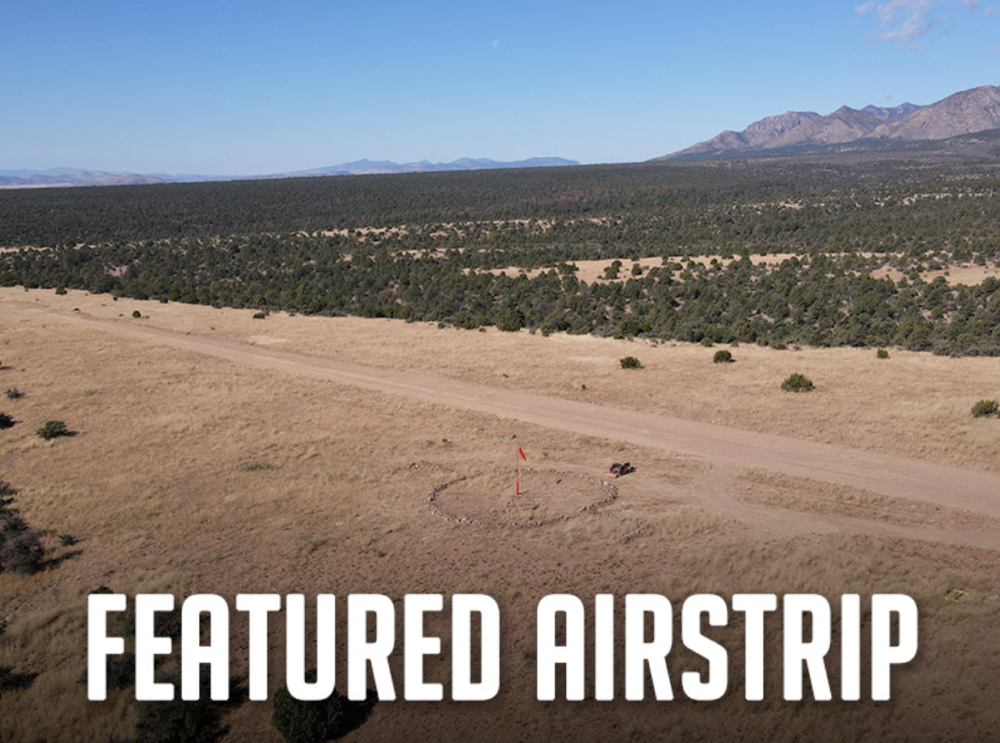
For adventurers seeking access to the Gila Wilderness, we suggest landing at Sacaton Airstrip, NM16, near Buckhorn, New Mexico. The runway lies on a “finger mesa,” and the Rain Creek trailhead lies just northeast of the field. Thanks to RAF New Mexico Liaison Ron Keller's coordination with the USFS using a Cost Share Agreement, Keller was able to organize RAF and New Mexico Pilot Association (NMPA) volunteers to rehabilitate and reopen the long-abandoned airstrip in 2022. Beyond reopening the airstrip, Keller added camping amenities, including picnic tables and a new vault toilet. Most recently, Keller oversaw the installation of new shade structures, most welcoming to campers and hikers. RAF and NMPA volunteers complete ongoing maintenance at Sacaton and other airfields in the Gila National Forest. You’ll see white-painted rocks along Sacaton’s 3,989-ft dirt runway, and surrounding the segmented circle near the RAF windsock. The airstrip lies at 6,200-ft elevation, so pilots should be mindful of density altitude while flying over high terrain in the vicinity, even in winter temperatures.  “Anglers will enjoy plying streams for the rare native copper-colored Gila trout, once a threatened species,” Keller reports. The mile-and-a-half trail to the crossing at Rain Creek is narrow and challenging and traverses a variety of terrain, but the serious hiker will be rewarded trekking through steep canyon walls lined with green alder, willow, and boxelder, hoodoos, and eagle aeries above. There are rumors of a double waterfall some distance on the west fork of Rain Creek trail. See the Sacaton page in the Airfield Guide for more details. Note that the airstrip may be unusable due to snow or after heavy rains. This runway should be considered one-way in/one-way out to avoid overflying the Wilderness boundary. There is a 4.6% upslope to the East, favoring landing Runway 08 with right traffic, remaining clear of the Wilderness east and north of the airfield. Please consider others seeking a Wilderness experience. Prior to landing at Sacaton, permission is required by calling the USFS Gila Dispatch center at 800-538-1644. Please familiarize yourself with Sacaton in the Airfield Guide and the New Mexico Pilots Association Safety Briefing . Submitted March 30, 2025 By Carmine Mowbray
By lellington March 29, 2026