NEW MEXICO VOLUNTEERS IMPROVE NEWLY-OPENED SACATON
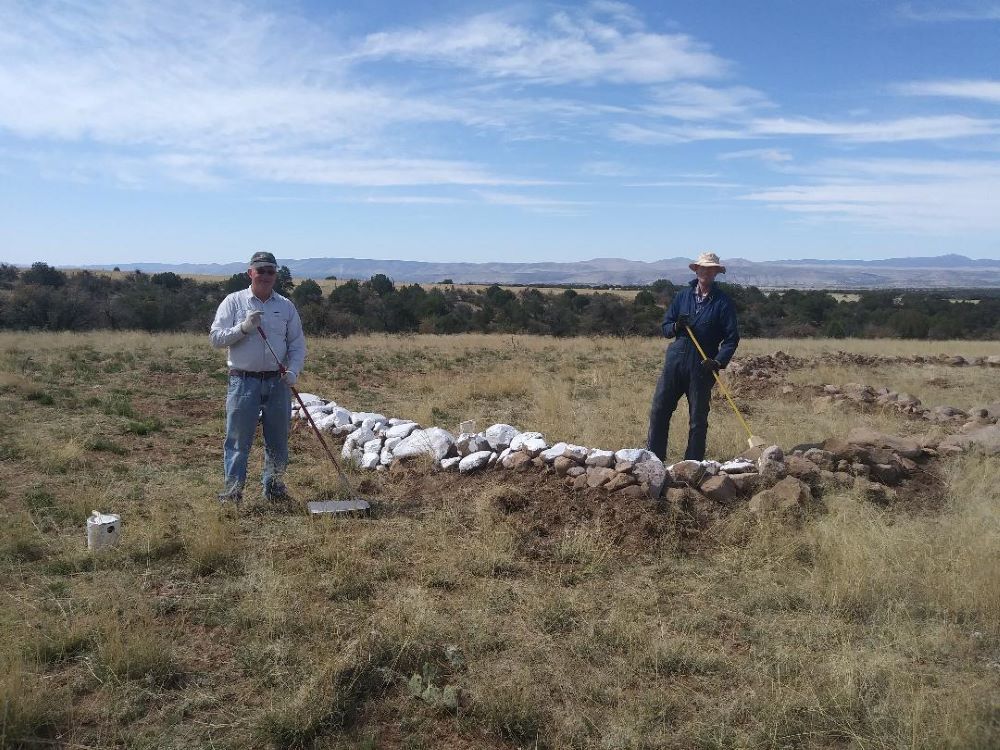
Once the USFS District Ranger deemed Sacaton “re-opened” last January after it had lain dormant and overgrown for decades, RAF New Mexico Ron Keller lost no time organizing help to improve it and make it safer and more appealing for recreation.


On the weekend of April 13-16 Keller gathered three volunteers to work on the airstrip, NM16 near Buckhorn, New Mexico. Keller arrived on Thursday, towing the large New Mexico Pilots Association enclosed trailer with tools and some modern conveniences. “I stopped at every cattle guard on the dusty county road – eleven total – to verify each was at least fourteen feet wide to be sure the semi-truck can deliver the vault toilet to the Rain Creek trailhead,” Keller said, in advance of its installation scheduled in the fall. Keller dragged the runway and set up camp in anticipation of the other volunteers’ arrival. 


Friday the winds prevented anyone flying in, so RAF Supporter and NMPA member Randy Roth drove his Jeep to Sacaton with NMPA member Jim Gosney. “The three of us got busy painting the segmented circle around the RAF windsock,” Keller said. “The circle is made from the repurposed large rocks that had formed an “X” in the middle of the old dormant runway,” he explained. They tossed rocks from the runway that had been dislodged by the dragging process. All but Keller drove back home. 

Saturday’s weather was perfect, so Randy and Jim flew the 30-minute flight back to Sacaton, followed by RAF Supporter and NMPA President John Lorenz, arriving after his two-hour flight.


With the painting complete, they tossed more rocks and hand-cut channels for water drainage. “John and I checked out the Rain Creek Trail into the Gila Wilderness, America’s first federally designated wilderness. It will celebrate one hundred years in 2024,” Keller pointed out. He reports that the mile and-a-half trail to the crossing at Rain Creek is narrow and challenging.


They packed up camp and returned home Sunday, leaving Sacaton in much better condition. Prior to landing, permission is required by calling USFS Gila Dispatch Center at 800-538-1644. At its 6,200-ft elevation, pilots should be mindful of density altitude. You may find more information in the Airfield Guide and a Safety Briefing at the New Mexico Pilots Association website.


Submitted on April 25, 2023.


Posted in News

    Recent Posts
June 18, 2026
Our many RAF supporters have such vast and varied experience, and we’re capturing some of their words of wisdom to share with you. This guest editorial is by Neil Mortine, a marketing and relations executive, RAF Supporter, and husband of RAF Ohio Liaison Christine Mortine.
June 17, 2026
Taylor Flat Airstrip, just a stone’s throw from the wild and scenic Green River as it carves through spectacular Utah canyons, is officially reopened. Thanks to a cooperative effort between the RAF and Utah Back Country Pilots (UBCP), Taylor Flat Airstrip, TF9, is one more recreational destination pilots can once again enjoy as the RAF works on Expanding The Map ! In 2023, dialog was initiated with the BLM to reopen the airstrip. Daggett County got involved, and RAF Utah Liaison Wendy Lessig navigated the required NEPA process. Lessig was instrumental in preparing a right of way (ROW) lease agreement application, coordinating between Daggett County, the BLM, and other stakeholders, and gathering information to assist the BLM throughout the required Environmental Assessment. “Thanks to Wendy taking action as the RAF Liaison, and her professional persistence following through the lengthy public review process, Taylor Flat Airstrip will reopen as another unique backcountry destination," RAF President Bill McGlynn said. The RAF and UBCP teamed up May 9 to revitalize the airstrip, which had lain dormant for thirty years. “The work party was a resounding success,” Lessig reports. ”We are grateful for the twenty-five volunteers who hand-picked rocks from the airstrip, and used them to mark the runway corners and threshold. “
June 16, 2026
Starting this month, we’re sharing messages from our RAF Safety, Education and Etiquette “SEE” committee. We hope you like the way we present these stories, and most importantly, we hope you’re one of those folks willing to sit around the campfire and help your friends become better at this thing we call backcountry aviation. We all see things that might not end well. We don’t intend to call anyone out for what might already be a bad day in someone’s flying life. In the interest of safety, we’re inviting you to be part of the culture starting with, “see something, say something.” The hard part might be how to politely deliver that message, and even more important, how to react if we are on the receiving end of someone’s comment. It takes maturity to accept input, especially at one of those moments when maybe we realize things could have just gotten much worse for us. I know I’ve been in “that place” when some thoughtful input about my flying or behavior has been offered. Part of flying is to always strive to be better; and when we aren’t at our best, try to own our shortcomings, learn from them, and move forward. I think about this often. I worry that if we don’t work at getting this part right, at best we risk losing access due to bad practices or behavior; and at worst we risk people getting hurt or worse. It’s that last piece that keeps me up at night. Of all the joys that doing this work brings us at the RAF, the risk of people getting hurt is what I think about the most. Safety, education, and etiquette are tied. Getting these right means the best outcome. So, get out there this summer. Get some grass stains on your wheels, get some bugs on your windscreen, get better at your craft of flying the airplane, meet some new people, and for sure start to create those special friendships that begin around a campfire under a starlit night. - John McKenna, RAF Chairman Submitted June 16, 2026
June 15, 2026
By RAF Director Bill Brine and the RAF's Safety, Education, and Etiquette Committee. Too many backcountry accidents happen on the third approach. After two unsuccessful attempts at landing, the pilot is tired, anxious, behind the airplane, and making decisions with a brain that has been running down since the first go-around. The airstrip hasn’t gotten easier. Third time’s NOT a charm. What’s driving this is cultural. Baseball is “three strikes, you’re out.” Could this thinking have joined us in the cockpit? We aren’t playing baseball out here. The backcountry does not give you that third strike. It gives you consequences. Our RAF Code of Conduct calls on each of us to establish personal minimums based on sound aeronautical decision-making — before we need them. Decide your limits at the kitchen table. Write it down. Brief your passengers. Commit to it before you start the engine. That’s when the rule does its job and leads to that hoped-for experience you set out on. Here is one worth considering: two attempts, fly away, head somewhere else . Not because your mission failed, but because you made a sound decision. Flying away is not defeat. Head to your alternate. Land, shut down, and let everyone decompress. Unload gear, leave passengers, go back solo, or call it a day. Those are good outcomes. Submitted June 15, 2026 Photo Credit: Scott Newpower
By Carmine Mowbray June 15, 2026
This month, the RAF is featuring our friend Charlie Gregoire, co-founder of innovative Redbird Simulators. Redbird's story is of a few guys who acted on their great idea to make it easier and more affordable for anyone to become a pilot. In 2006, they imagined a flight simulator that made a pilot feel like they were flying a real airplane. “We thought a decaying Cessna Cardinal RG was the perfect prototype,” Charlie said, and “Redbird” was born. “After a few more not-quite-right prototypes, we arrived at our first product, the Redbird FMX.” And driven by the idea to make initial flight training affordable, Redbird FMX is a great primary loggable training platform. Since then, Redbird has delivered over 7,000 aviation training devices to more than 60 countries. From desktop models to full-motion units, “We’re proud of the revolutionary changes our employees and customers are bringing to this industry we are all so passionate about,” Charlie says. Charlie also serves as a member of the special RAF group of volunteers we call the Vy Group. Pilots know that Vy is the “best rate of climb” speed, and these folks help steer the RAF in ways to “gain altitude” efficiently. Redbird and the RAF have partnered on the idea to prepare pilots for the unconventional demands of backcountry flying. Redbird has incorporated backcountry training scenarios, and graciously shares their wide selection of “off pavement” experiences by inviting pilots to try their hand in simulators at aviation events, like AirVenture and Sun ’n Fun. This year we invite you to Redbird’s interactive display at AirVenture, booth 301. While there, enjoy coffee and donuts with the Redbird team and us from 8:30 am to 10:30 am on Tuesday, July 21. Charlie and his team recognize the value of partnerships like ours. He says partnerships are an important part of Redbird’s past and future success. We share a common goal to make GA as safe as possible – wherever, and whatever you choose to fly – and keep it strong with passion, dedication, and commitment. See Redbird’s complete story here . Submitted June 15, 2026 By Carmine Mowbray